
DAS-UL10(10) / (20) · Integrated DAS interrogator
10/20 km integrated DAS combining acquisition and edge analysis.
4th-Generation Integrated DAS-UL10 Distributed Acoustic Sensing System
4th-Generation Integrated DAS-UL10 Distributed Acoustic Sensing System
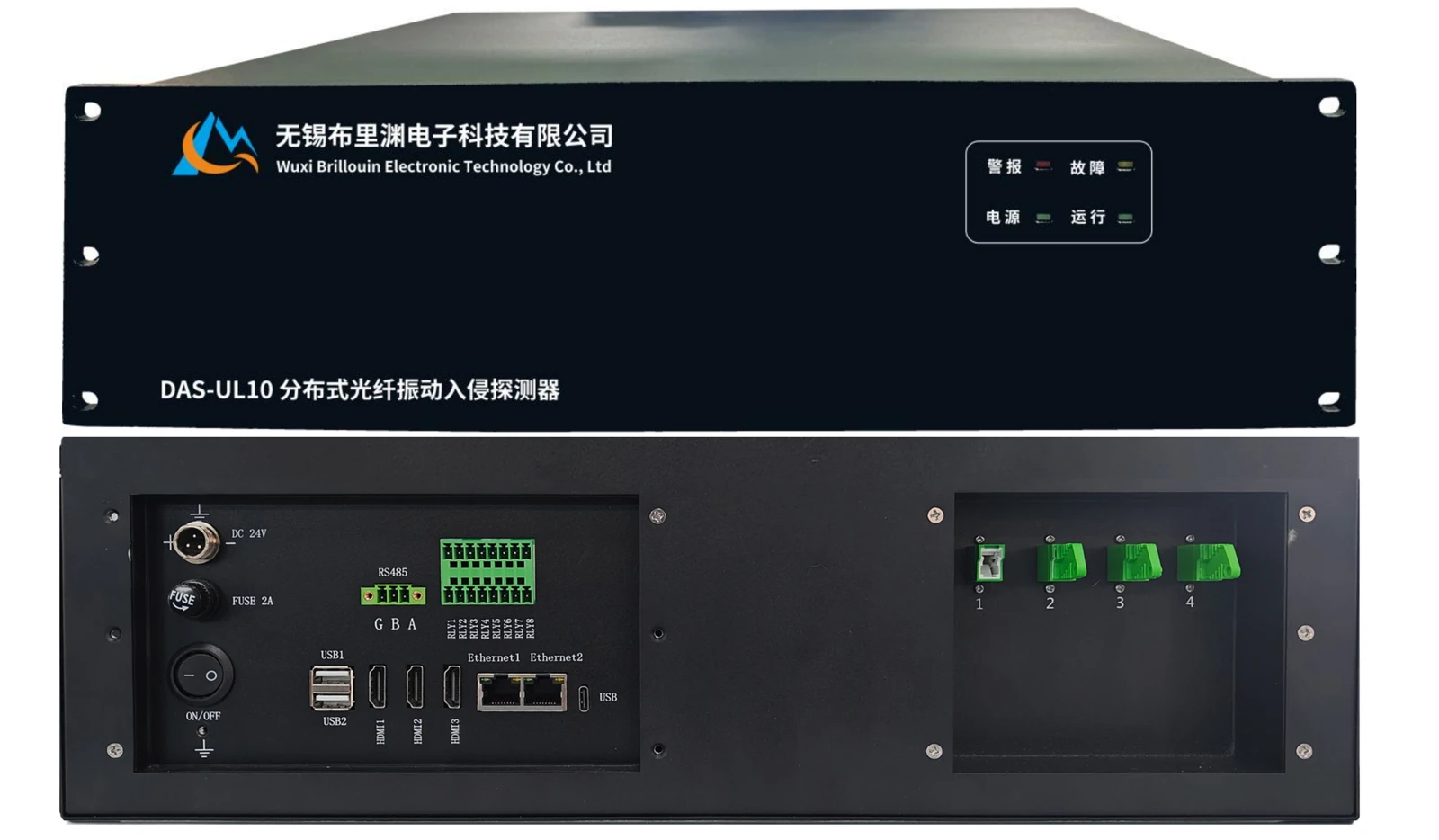
Integrates coherent phase sensing and an eight-core AI edge platform for parallel acquisition, waveform/audio reconstruction, event recognition and integration.
Equipment interfaces
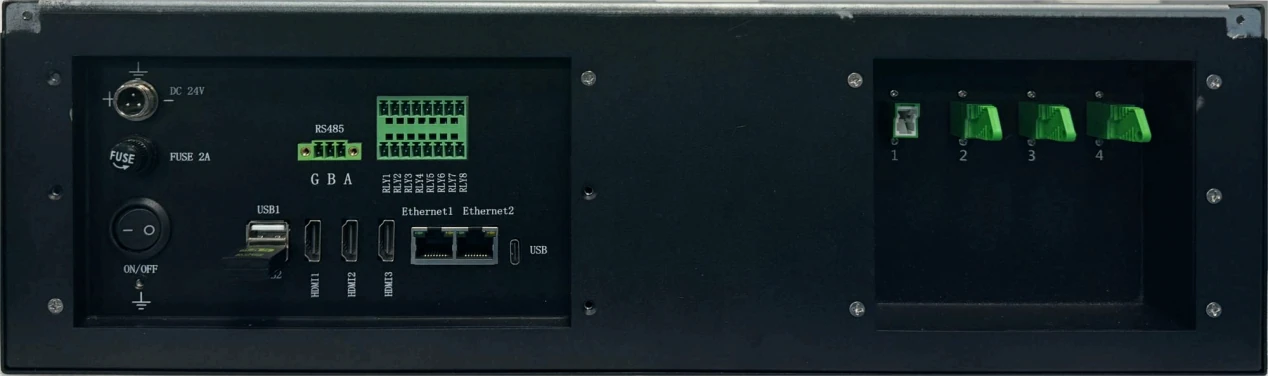
Interface layout, power and channel count depend on model and supplied configuration. Fiber sample spacing, gauge length and event-location error are distinct specifications.
Technical specifications
| Host Device Specification | DAS-UL10(10) | DAS-UL10(20) |
|---|---|---|
| Maximum Sensing Distance | 10 km | 20 km |
| AI Computing Model | Standard | Enhanced |
| Scan Frequency | Adjustable according to fiber length (10 km @ 10 kHz) | Adjustable according to fiber length (20 km @ 5 kHz) |
| Item | Specification |
|---|---|
| Device Type | Coherent phase-detection type |
| Fiber Type | Fiber core type: single-mode fiber, 9 um/125 um Core count, outer jacket dimensions, and material properties are configured according to the engineering application. |
| Number of Sensing Channels | Optional 1/2/4 channels; native multi-channel physical optical hardware channels with parallel real-time synchronous acquisition and no time blind zone (not based on optical-switch polling). |
| Sampling Interval | Adjustable: 0.4 m / 1 m / 2 m / 5 m |
| Spatial measurement setting | 0.4–25 m (project setting; gauge length and location error require separate confirmation) |
| Alarm Response Time | ≤ 3 s (minimum 1 s) |
| Phase Demodulation Accuracy | 0.1 rad (typical) |
| Audio Reconstruction | Yes |
| Vibration Demodulation Frequency Accuracy | Frequency accuracy: ±1 Hz |
| Vibration Demodulation Frequency Range | 0.1 Hz - 100 kHz (depending on fiber length) |
| Built-in Platform | Built-in 8-core AI edge computing platform with self-learning capability and AI model training functions, including a web server, FFT data processing, separation and phase unwrapping, GIS mapping, AI-based scenario training/classification, and early warning functions. |
| Operating Voltage | DC 24 V, average power consumption approx. 25 W |
| Communication Interfaces | 2 x RJ45 (Gigabit Ethernet) / 1 x RS485 / 2 x USB / standard 8 x relays / 3 x HDMI |
| Supported Protocols | Modbus RTU / Modbus TCP / custom phase transmission protocols, etc. |
| Optical Connector | E2000 dustproof self-locking connector; FC/APC customizable |
| Laser Safety Class | Class 1 |
| Operating Temperature | -10 °C to 50 °C |
| Storage Temperature | -20 °C to 70 °C |
| Dimensions (W x D x H) | 482.6 mm x 326 mm x 132.8 mm |
| Weight | 13 kg |
Frequency range depends on fiber length, scan rate, gauge length and SNR. The 100 kHz upper limit applies only to short-range configurations with adequate high-speed sampling, not simultaneously across a 30–100 km fiber. Conventional per-point temporal sampling must satisfy the Nyquist criterion with anti-aliasing margin.
An alarm response ≤3 s requires compatible acquisition and trigger settings. Low-frequency validation needs a sufficiently long observation window; 0.01 Hz analysis does not imply complete event classification within 1–3 s.
Applications and further reading
Discuss your project with our engineer
Corporate Sales TeamCorporate contact
Contact us ↗