
ZFDS-16 · AI zoned fiber-optic perimeter intrusion detection
Intrusion sensing and security integration across 16 independent perimeter zones.
Zone-Based Fiber-Optic Fence Intrusion Detection System Technical Datasheet
Zone-Based Fiber-Optic Fence Intrusion Detection System
Technical Datasheet
16 independent zones · Local AI training and inference
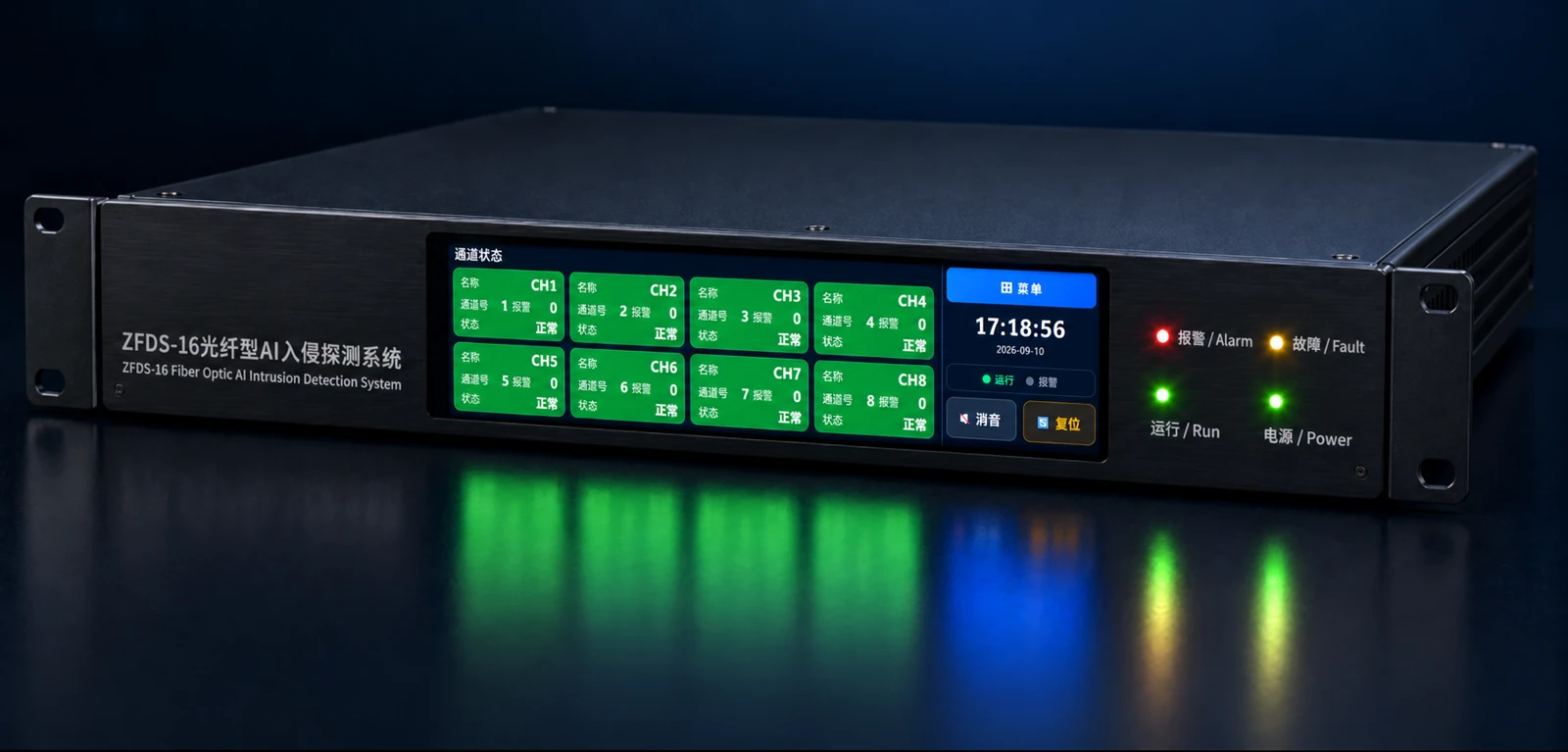
1U processor enclosure illustration
Product overview
ZFDS-16 uses passive sensing cable to detect disturbances on fences, wall tops and buried perimeters. Optical acquisition, signal processing and AI identify intrusion events and report the affected zone for security response.
Key features
16 independently configurable zones with individual enable status, sensitivity, AI model and relay mapping.
Local training and edge inference with baseline learning, event classification, alarm review and relabeling.
No power is required at the optical sensing front end; fiber links resist EMI in power and industrial sites.
RJ45, RS485, relays and data forwarding support video, sound/light alarms and security platforms.
Typical applications: substations, energy storage sites, oil/gas facilities, chemical parks, factories, warehouses, data centers, airports, ports and water facilities.
Detection and zone specifications
| Item | Specification |
|---|---|
| Product type | Zone-based fiber-optic perimeter intrusion detection system |
| Sensing principle | Fiber-optic interferometric/vibration sensing with optical acquisition and AI |
| Independent zones | 16 independent zones |
| Sensing cable per zone | Typical ≤ 1500 m; subject to sensing unit, barrier, routing and commissioning |
| Lead-in transmission distance | Typical ≤ 20 km; longer-distance configurations available by project |
| Alarm location reporting | Zone ID/name linked to a configured map area |
| Alarm response time | ≤ 3 s with a qualifying trigger configuration; project-configurable |
| Intrusion events | Climbing, cutting, impact, tampering, digging and footsteps |
| Environmental discrimination | Supports learning of wind/rain, vehicles, animals, vegetation and maintenance |
| Zone configuration | Name, enable state, fiber-break alarm, sensitivity, model, thresholds and mapping |
| Optical path faults | Zone fiber-break alarm and abnormal-status reporting |
| Processor supervision | Self-test, enclosure tamper and acquisition/processing/AI service status |
| Operation | 24/7 online monitoring with local/intranet deployment |
| Field sensing power | No local power for sensing cable and matched passive sensing units |
Length and response definitions
The 1500 m figure is a typical sensing-cable length per zone. Multiple runs and serpentine/return routes reduce the corresponding perimeter coverage. The 20 km figure describes the lead-in link.
Location is reported by zone, not by DAS-style point accuracy or spatial resolution. Response depends on classification, time window and trigger count; external network and actuator delays are additional.
Processor interfaces and operating conditions
| Item | Specification |
|---|---|
| Enclosure | 19-inch 1U rack enclosure; indoor cabinet installation with shelf support |
| Status indication | 16-zone status plus run, power and AI indicators |
| Optical connectors | FC/APC; connect zone optical outputs/inputs to the supplied port map |
| Cable configuration | Matched sensing and lead-in cables; core count, jacket and optical topology by project |
| Ethernet | RJ45 for configuration, monitoring, alarms and data integration |
| Serial interface | RS485 for bus communication and external relay expansion |
| Maintenance | USB for maintenance, data/configuration and upgrade-file management |
| Internal relay outputs | Outputs 1–20 shown as internal relays; mapping for 16-zone alarms and system/fault/custom functions |
| Relay expansion | External RS485 relay modules supported; configure the actual module count |
| Input supply | DC 12 V, reference configuration 1.5 A; 24 V version subject to project confirmation |
| Power consumption | Typical ≤ 18 W, including the built-in AI edge configuration |
| Processor temperature | −10 °C to +55 °C; extended-temperature version by project |
| Sensing-unit temperature | −40 °C to +70 °C; field cable/accessories selected to their own specifications |
| Operating humidity | 0–95 %RH, non-condensing |
| OS and localization | Domestic OS/industrial Linux; optical components, ADC, FPGA and SoC per agreed configuration |
Confirm relay contact ratings and NO/NC form, chassis depth/weight, optical port count and backup input against the supplied wiring drawing and order. External SMS, sound/light and video devices require separate power.
AI recognition and software capabilities
| Item | Specification |
|---|---|
| Recognition modes | Anomaly detection and event classification, selected per zone |
| Anomaly detection | Models normal conditions where intrusion samples are difficult to obtain |
| Event classification | At least two classes, including at least one alarm-triggering intrusion class |
| Sample capture | Manual capture adds the current 5 s signal window with an event label |
| Training prerequisites | At least 40 samples per class; performance depends on representative data |
| Pretraining | At least 300 pretraining records; automatic temporal and feature-based collection |
| Classification threshold | Adjustable 0–100; common starting value 80; a model decision threshold |
| Alarm trigger logic | At least y qualifying detections within x seconds; configure both together |
| Model management | Local training, pretraining, fine-tuning, deployment, versioning and import/export |
| Signal analysis | Live multichannel signals, single-channel waveform, FFT and STFT views |
| Alarm review | Alarm details, original signals, false-alarm relabeling, statistics and action records |
| Visualization | Online maps or uploaded background images; zone overlays, scene and grid modes |
| Users and maintenance | Super-admin, admin and read-only roles; reset password, logs, time and updates |
A threshold of 80 is not an 80% product accuracy claim. A validation confusion matrix is available for classifiers; field detection, misses and nuisance alarms should be assessed separately by event type.
Training duration varies with sample volume and edge resources. Reviewed alarms can be relabeled, retrained and redeployed to the relevant zone; imports use system-supported formats.
Software views and integration
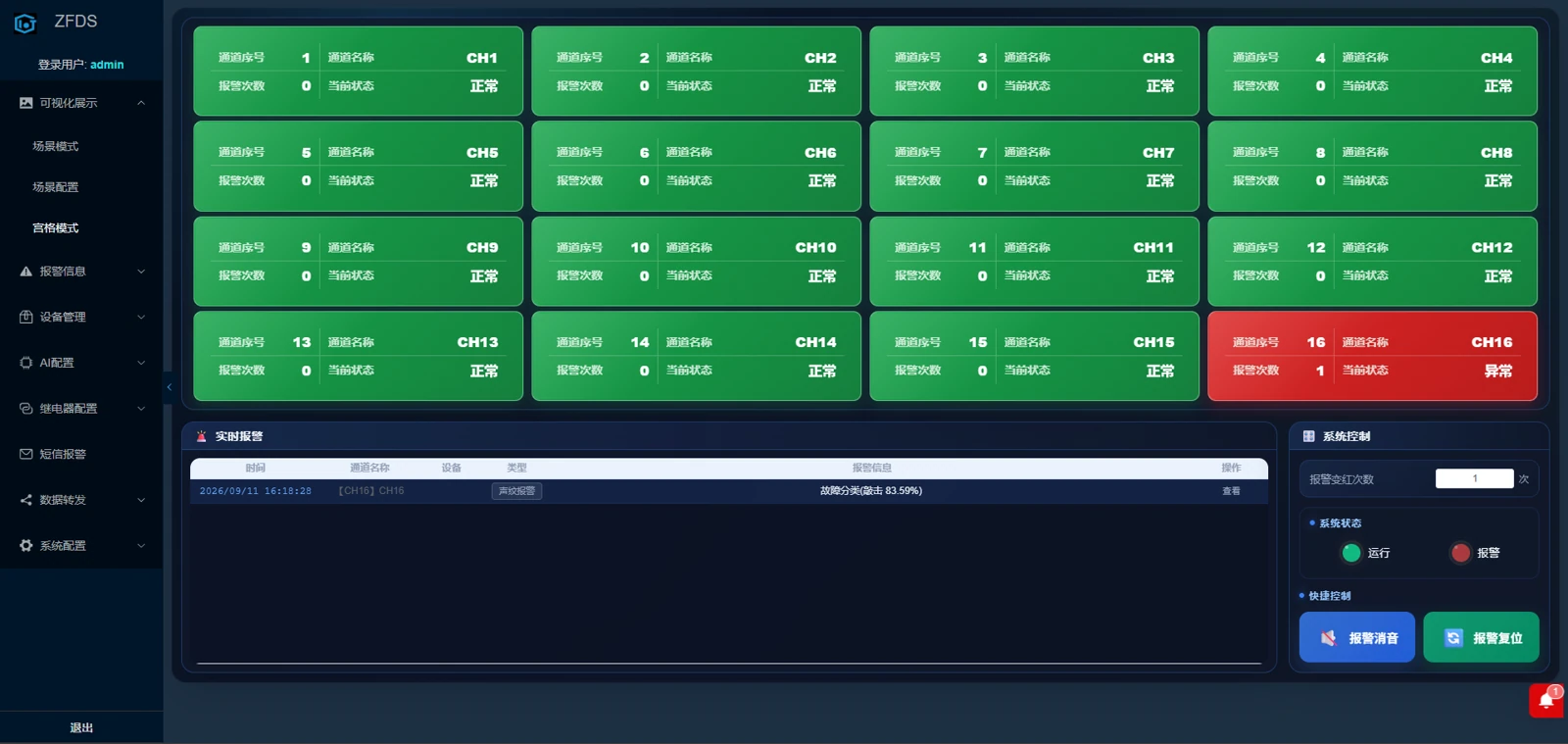
16-zone dashboard and alarm status
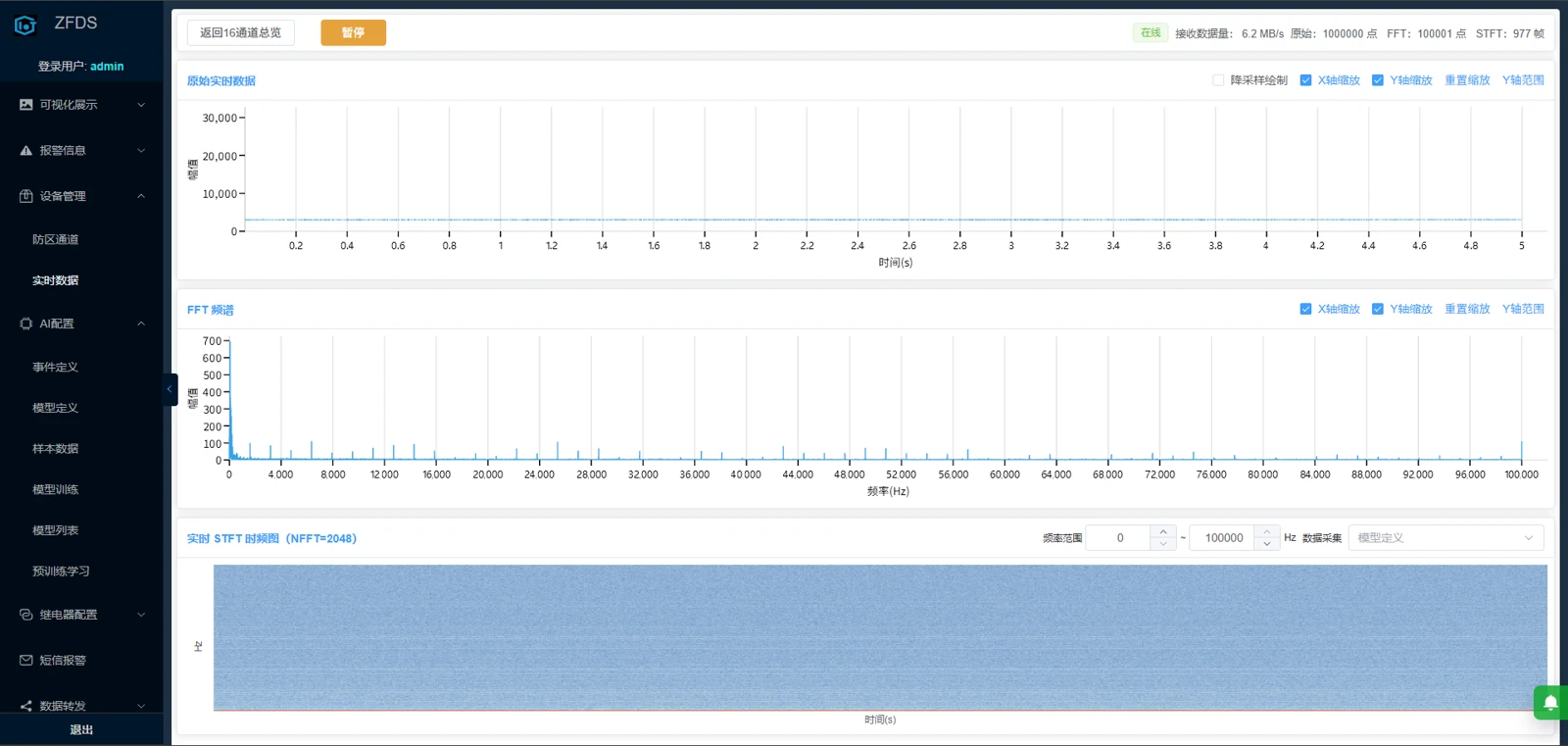
Waveform FFT and STFT analysis
| Item | Specification |
|---|---|
| TCP forwarding | Raw channel signal integration; server mode available |
| Modbus TCP / RTU Modbus TCP / RTU | Zone information read/write; RTU over RS485 |
| Alarm integration | Relay mapping, sound/light, video presets and platform alarms; SMS requires an external module |
| Alarm controls | Mute/reset, repeat-alarm interval and operation/action logs |
Protocols and video links follow project integration tests. Offline sites can use uploaded plans. Screenshot ranges and data counts do not establish hardware sampling specifications.
Installation and optical-link design
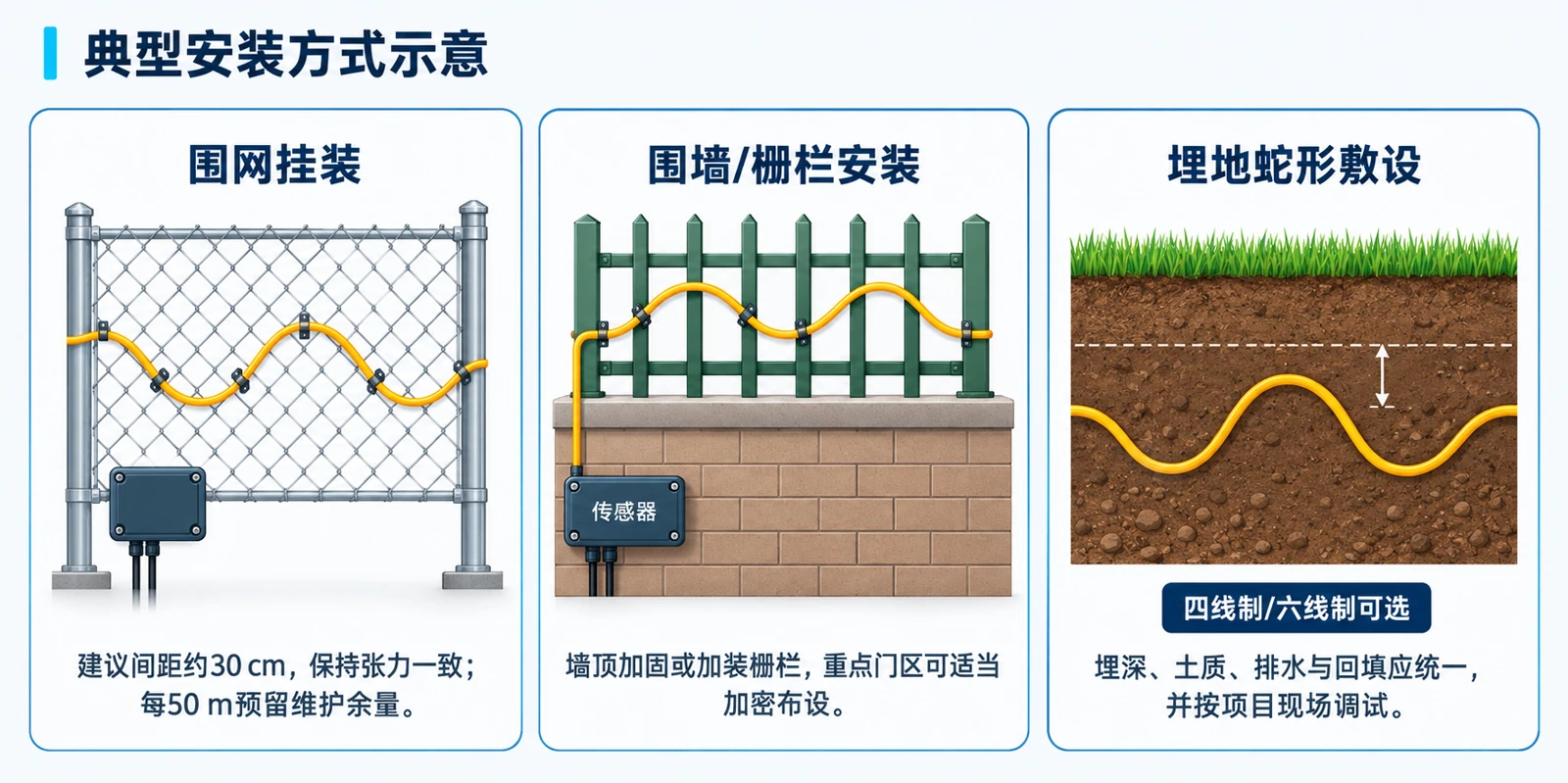
Fence wall-top and buried installation concepts
Zones and optical paths
The system comprises the processor, matched sensing units, sensing and lead-in cables, and software. Lead-in fibers connect the room to the field; sensing cable couples mechanically to the barrier. Document core allocation, transmit/receive paths and zone mapping.
| Item | Specification |
|---|---|
| Fence mounting | Fix along rails/posts or in a wave route; typical mesh-fence spacing 30 cm with consistent tension; maintenance loops at 50 m where suitable |
| Wall tops and gates | Couple through wall-top mesh/railings; allocate separate zones or denser routing at gates, corners and weak points |
| Buried installation | Serpentine/multiple runs with consistent depth, spacing, soil and backfill; validate footsteps/digging on site |
| Splicing and protection | Recommended splice loss ≤ 0.2 dB; test end-to-end loss and provide sealing, strain relief and labels |
Cable specifications govern fixing intervals, bend radius, tensile load and jacket resistance. Use a supported, ventilated and grounded cabinet; cap unused optical ports and never look into active fibers.
Ordering and performance acceptance
| Item | Specification |
|---|---|
| Processor model | ZFDS-16 / ZFDS-16 AI; 16 zones, 19-inch 1U |
| Sensing and lead-in links | Confirm zones, cable lengths, actual perimeter lengths, lead-in distances, topology and sensing units |
| Field materials | Select jacket, core count, splice enclosures, fixings and protection for fence/wall/buried routes |
| Power and environment options | Standard DC 12 V; 24 V, extended temperature and outdoor enclosure options by project |
| External integration options | External relays, SMS module, sound/light, video and protocol integration as required |
| Deliverable documents | Wiring drawings, zone/relay maps, protocol files, configuration backups and model versions |
Site acceptance checks
Coverage: verify zone boundaries, gates, corners and weak points using appropriate climbing, impact, cutting simulations or buried disturbances.
Recognition: record trials, correct detections, misses and misclassifications separately from nuisance alarms; log observation time, zone/perimeter length and weather.
Response: timestamp event onset, software alarm, relay action and video response against the agreed windows, thresholds and trigger counts.
Faults: test fiber cut, tamper, network loss, power restoration, arming, mute/reset, permissions and logs; verify remaining coverage against the installed optical topology.
Agree detection/nuisance-alarm targets and laser, EMC, electrical-safety and enclosure test requirements in the technical agreement, supported by applicable model-specific records or reports. Typical values support selection; final supply follows the agreed technical documents.
Applications and further reading
- Multi-parameter fiber safety monitoring for petrochemical facilities and chemical parks
- DAS perimeter intrusion monitoring for industrial parks and critical sites
- Integrated fiber safety monitoring for hazardous-material storage and loading
- Fiber-optic intrusion monitoring for power plants, substations and critical infrastructure
Discuss your project with our engineer
Corporate Sales TeamCorporate contact
Contact us ↗