
BLY-SOACC-3-XXX · Three-axis silicon photonic accelerometer
XYZ acceleration for local blade vibration, rotational response and abnormal changes.
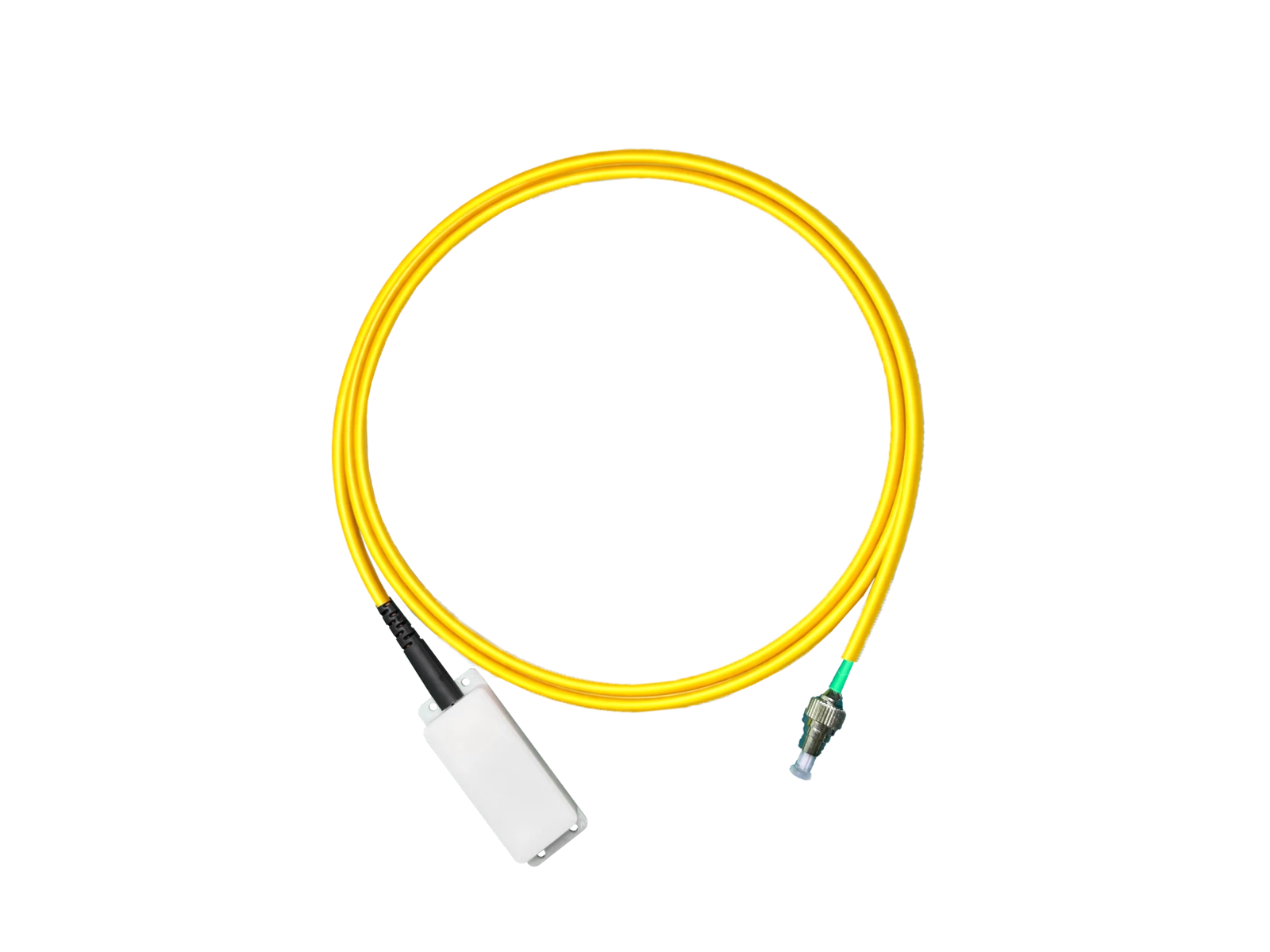
Fiber-Optic Three-Axis Silicon Photonic Accelerometer
Fiber-Optic Three-Axis Silicon Photonic Accelerometer
Product overview
A passive three-axis optical sensing head based on silicon photonic reflective pulse coding. It measures vibration, impacts and low-frequency motion, and supports static tilt estimation from gravity components. Designed for condition monitoring, health assessment and predictive maintenance of rotating machinery, wind turbine blades and infrastructure.
Single-mode fiber supports transmission applications beyond 2 km, subject to interrogator configuration, optical loss and connections. Passive sensing and electrical isolation suit high voltage, strong EMI, lightning-prone locations and difficult-to-maintain sites.
Standard range is ±4 g, with ±8 g or ±16 g options. Standard detection band is 0–2 kHz; 0–4 kHz requires a custom configuration. Three-axis acceleration alone is not a complete independent attitude solution; dynamic analysis also requires speed, installation orientation and a motion model.
Typical applications
Transformers, generators, motors, GIS and step-up equipment; petrochemical units, tanks, terminals and mine conveyors; wind turbine blades, offshore wind, bridges, tunnels, towers, slopes and railways; hydro units, thermal/nuclear auxiliaries and large rotating equipment.
Technical specifications
| Item | Specification |
|---|---|
| Operating Temperature Range | -40 °C to 65 °C |
| Storage Temperature Range | -40 °C to 85 °C |
| Operating Humidity Range | 0 % to 95 % RH, non-condensing |
| Corrosion Resistance | C5-M |
| Ingress Protection | IP67 |
| Altitude | ≤ 4000 m |
| Measurement Principle | Silicon photonic reflective pulse coding |
| Fiber Type | 9 μm / 125 μm single-mode fiber |
| Measurement Range | ±4 g (customizable to ±8 g or ±16 g) |
| Overload tolerance | ±50 g |
| Detection Frequency | 0 Hz to 2 kHz (0-4 kHz customizable) |
| Resonant Frequency | ≥ 2 kHz |
| Noise density | ≤ 50 μg/√Hz |
| Resolution | 125 μg |
| Nonlinearity | ≤ 0.5 % |
| Minimum Pigtail Bend Radius | Protected cable: 50 mm Unprotected cable: 50 mm |
| Connector Type | FC/APC, LC/APC, MPO and other optical connectors; FC/APC preferred |
| Dimensions (L x W x H) | ≤ 50 mm x 17 mm x 12 mm |
| Weight | ≤ 0.2 kg |
| Mounting Method | Ergo1665 adhesive bonding |
| Crush Protection | ≥150 kg equivalent load; verify under specified contact-area and duration conditions |
Interfaces and installation
| Model | Configuration |
|---|---|
| BLY-SOACC-3-XXX | Sensor head and pigtail; standard 3 m with FC/APC. XXX denotes the configuration code defined by the order. |
Bond with Ergo1665 on a clean, flat surface; align and secure the head as required and protect the pigtail. Minimum bend radius is 50 mm for both protected and unprotected versions. Place near the source or structural point and avoid loose mounting or unnecessary impacts.
For lengths beyond the standard 3 m pigtail, extend using compatible fiber splicing. Qualified personnel should handle connector removal, splicing and protection in accordance with the optical design. Total loss and length must meet interrogator requirements; connectors and pigtail lengths are configurable.
Use with a BLY silicon photonic interrogator and host/acoustic-analysis platform. Performance depends on placement, noise, structure, mechanical coupling and training. Static tilt estimation requires low-dynamic conditions or motion compensation.
Sensor response, interrogator scan rate and interface output rate are separate specifications. Raw 2 kHz or 20 kHz waveforms require sufficient sampling and transport bandwidth. A ≥50 Hz status output does not establish these raw-waveform capabilities; confirm the required high-speed acquisition mode.
Apply ingress, corrosion and overload ratings under the test conditions for the supplied configuration. Passive-fiber electrical isolation does not replace complete-system suitability verification for hazardous areas.
Applications and further reading
- Multi-hazard fiber sensing and rescue-support localization in underground coal mines
- Multi-parameter fiber monitoring for substation GIL, busbars and transformers
- Fiber sensing for cable temperature and equipment condition across steel production
- Fiber sensing for photovoltaic plants, charging facilities and distributed energy
Discuss your project with our engineer
Corporate Sales TeamCorporate contact
Contact us ↗