
Project background: from isolated alarms to continuous risk assessment
DAS seismic and ocean observation using subsea cables and urban dark fiber addresses the long-term safety and condition management of subsea telecommunications cables, urban dark fiber, research networks and coastal or terrestrial seismic monitoring routes. Such assets commonly span multiple spaces, process sections or asset identifiers; risks can move along routes, equipment boundaries and structural weaknesses rather than appearing at predetermined measuring points. Key concerns include very long distances, complex coupling, traffic and vessel backgrounds, ocean motion, large datasets and reproducible research algorithms. Point sensors, manual inspections and video provide local evidence but may not capture the complete development of an anomaly from onset to response.
The solution uses advanced DAS, dark-fiber arrays and silicon-photonic sensors, placing sensing fiber along the paths that need observation to create continuous, localized and replayable records. Its objective is to convert existing telecommunications fiber into a dense linear array that continuously records seismic waves, ocean activity, vessels and urban environmental vibration, rather than add isolated equipment. Start design with an asset-risk inventory and verifiable monitoring objectives, then specify range, spatial resolution, sampling, sensing-cable construction, software interfaces and alarms.
Risk progression and monitoring boundaries
For subsea telecommunications cables, urban dark fiber, research networks and coastal or terrestrial seismic monitoring routes, distinguish initiating factors, early signs, developing conditions and consequences. Risks including very long distances, complex coupling, traffic and vessel backgrounds, ocean motion, large datasets and reproducible research algorithms may occur independently or arise from combined load, environmental, construction and maintenance effects. Capture measurable changes in temperature, acoustics, vibration, strain or local condition and associate them with specific assets and distances.
Sensing principles and technology selection
DAS uses coherent Rayleigh backscatter to turn standard communications fiber into a continuous acoustic and vibration array. External disturbance changes the local optical path; interrogation produces time-distance waveforms, spectra and event trajectories. Beyond locating vibration, analysis of duration, propagation speed, frequency content and spatial continuity can help distinguish vehicles, machinery, excavation, tapping, leaks and natural background.
The recommended combination is advanced DAS, dark-fiber arrays and silicon-photonic sensors. Check monitoring distance, spatial resolution, localization accuracy, channel count, dynamic range, sampling cycle, operating temperature and communications together. Specifications should support the objective to convert existing telecommunications fiber into a dense linear array that continuously records seismic waves, ocean activity, vessels and urban environmental vibration, rather than be compared individually. For long routes, prioritize signal-to-noise ratio, reliable localization and far-end stability; for localized high-risk areas, assess coupling, effective sensing length and response time.
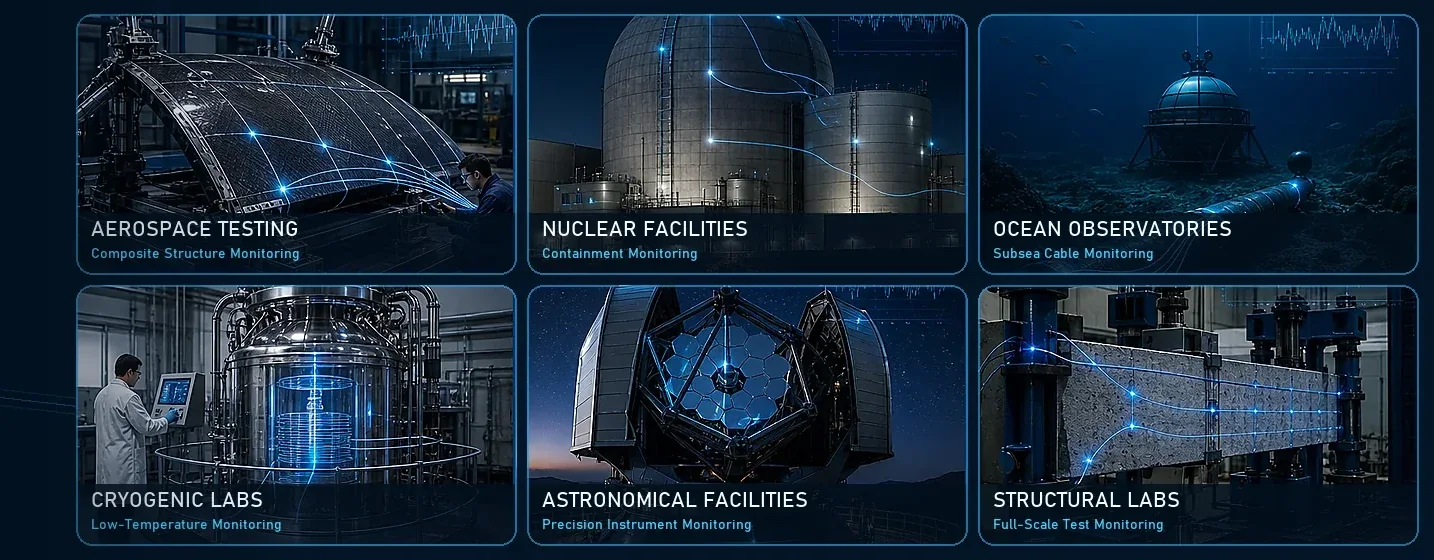
System architecture: sensing, interrogation, software and response
The system comprises sensing cable or fiber sensors, splicing and protection units, interrogation equipment for advanced DAS, dark-fiber arrays and silicon-photonic sensors, edge processing, application software and supervisory interfaces. Returned signals undergo quality checks, distance calibration and parameter calculation before mapping to asset records. Outputs include live curves, time-space plots, event lists, risk zones, historical trends and reports, rather than an unexplained waveform.
Connect to research platforms, earthquake catalogs and ocean-observation systems using open formats, batch processing and iterative algorithms. Define the data dictionary, time synchronization, alarm acknowledgment, offline buffering and recovery upload. For important projects, use tiered retention of raw or feature data to support incident reviews, algorithm improvement and threshold changes.
Sensing cable and field installation
Recommended installation: select available dark fiber and stable equipment rooms, calibrate at route bends, landing stations and known seismic stations, and retain raw data and time synchronization. Installation quality directly affects results; the same interrogator can respond differently with different mounting, jacket materials and coupling. Design documents should identify start/end distances, slack loops, splice boxes, zone boundaries, fastening intervals, bend radius, pulling tension and protection.
Data analysis and graded alarms
Combine adaptive background learning with rule-based constraints. Build backgrounds for day/night, working days, seasons and equipment states, then classify energy, frequency bands, pulse density, motion trajectories and repetition. AI can improve recognition in complex backgrounds, but high-risk alarms must retain explainable waveform, spectrum, distance and duration evidence for operator review.
Initial application criteria: preprocess wavefields, analyze frequency bands, detect events, estimate velocities and compare stations while accounting for cable directionality and coupling differences. Use advisory, early-warning, alarm and emergency levels, each with defined confirmation times, verification and actions. Calibrate thresholds against actual conditions during trial operation and record every revision, reason and effective date. Display position, asset name, measured value, baseline deviation, duration and supporting evidence together.
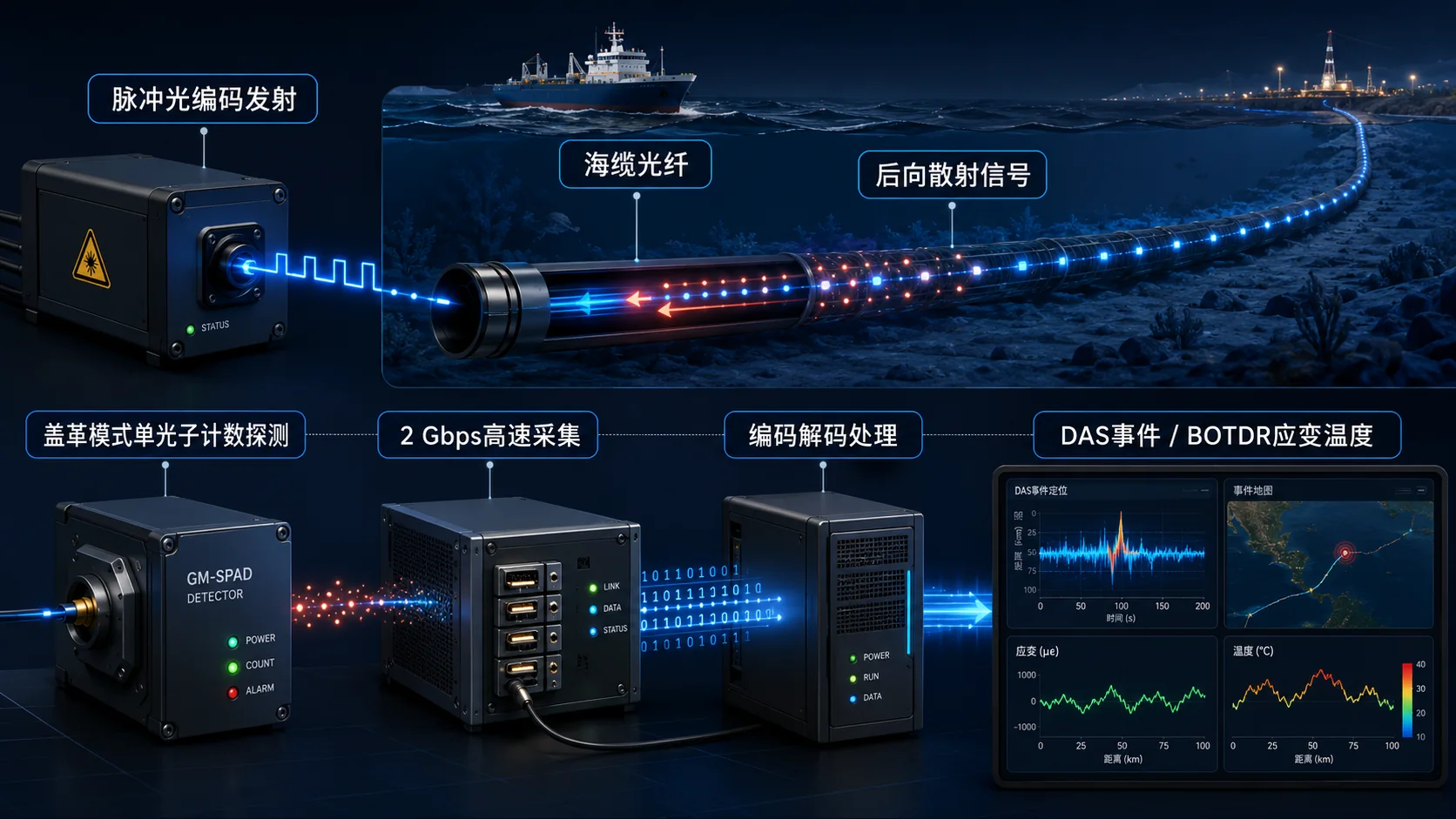
Commissioning, acceptance and performance verification
Acceptance should include at least three repeatable event types, testing localization, detection rate and false-alarm suppression at near, middle and far sections. Record construction methods, distance, ground conditions, cable installation and background noise. A single tapping test cannot replace validation under actual operating conditions.
Maintenance and sustained effectiveness
Maintenance assessment should cover valid-alarm rates, confirmation time, false-alarm causes, missed-event reviews, closed work orders and detected trends, not just equipment uptime. Continued labeling of real events can improve recognition models and sustain practical performance after commissioning.
Integration with existing systems
Connect to research platforms, earthquake catalogs and ocean-observation systems using open formats, batch processing and iterative algorithms. Let the fiber platform handle interrogation, curve analysis and original evidence, while the supervisory system manages consolidated displays, duty workflows and work orders. Depending on the project, interfaces may use Modbus TCP, OPC UA, IEC protocols, REST APIs, message queues or dry contacts. Avoid transferring only an unexplained aggregate alarm.
Every alarm on a map, plan or process diagram should link back to original curves and historical trends. Feed dispositions from supervisory systems back into event records, closing the loop between monitoring, confirmation, response, review and threshold improvement.
Benefits, operating conditions and technical boundaries
The solution replaces sampled inspections of subsea telecommunications cables, urban dark fiber, research networks and coastal or terrestrial seismic monitoring routes with continuous observation, retaining traceable early indications of very long distances, complex coupling, traffic and vessel backgrounds, ocean motion, large datasets and reproducible research algorithms. Passive fiber, electromagnetic immunity and multiple sensing locations on one fiber can reduce distributed power and maintenance requirements on long routes, at unattended sites or in hazardous environments. Locations and trends help teams narrow inspections, plan condition-based maintenance and prioritize risk.
Equipment selection and detailed design
Begin with five questions: which parts of subsea telecommunications cables, urban dark fiber, research networks and coastal or terrestrial seismic monitoring routes require protection; which indications of very long distances, complex coupling, traffic and vessel backgrounds, ocean motion, large datasets and reproducible research algorithms must be detected; what localization, response and sampling performance is needed; what routing, power, communications and cabinet facilities are available; and who confirms alarms and owns the response workflow?
Then specify the combination of advanced DAS, dark-fiber arrays and silicon-photonic sensors, cable construction, single- or double-ended optical paths, channel redundancy, software licensing and interfaces. For phased projects, reserve fiber, rack space, network addresses and platform capacity. For long-distance or multisite projects, evaluate centralized interrogation, distributed edge nodes and remote maintenance together.
Application-specific validation and limitations
Dark-fiber routes, burial methods and environmental coupling often lack complete records; first document the available routes. DAS mainly observes dynamic responses along the fiber axis. Bends, orientation and seabed contact affect wavefields, so a communications route should not automatically be treated as a uniform seismic array.
Research datasets should retain synchronization, channel locations, acquisition parameters and instrument response, distinguishing raw records from processed results. Ships, waves, road traffic and other human activity can overlap signals and require contextual data. Comparisons between routes should state differences in geometry and acquisition conditions.
Installation, optical-path calibration and acceptance checklist
Related products and technical resources
Explore the product categories below according to distance, spatial resolution, channels, response and site conditions. Published specifications support preliminary selection; final configuration must account for optical loss, installation and acceptance objectives.
Related equipment and specifications
Select the final model and installation to suit project conditions.
DAS-UL10(N30) / (N70)
Generation 5 low-frequency DAS
BLY-SOACC-3-XXX
Three-axis silicon photonic accelerometer
BLY-SOACS-1-XXX
Fiber-optic acoustic signature sensor
BLY · DTS / DAS / BOTDA / BOTDR
BLY sensing cables