
DAS-UL10(N30) / (N70) · Generation 5 low-frequency DAS
Generation 5 N30/N70 for low-frequency response and multiband coherent demodulation.
5th Generation DAS-UL10 (N Series) Distributed Acoustic & Vibration Sensing System
5th Generation DAS-UL10 (N Series) Distributed Acoustic & Vibration Sensing System
DAS-UL10(N30) / DAS-UL10(N70) | Product Datasheet
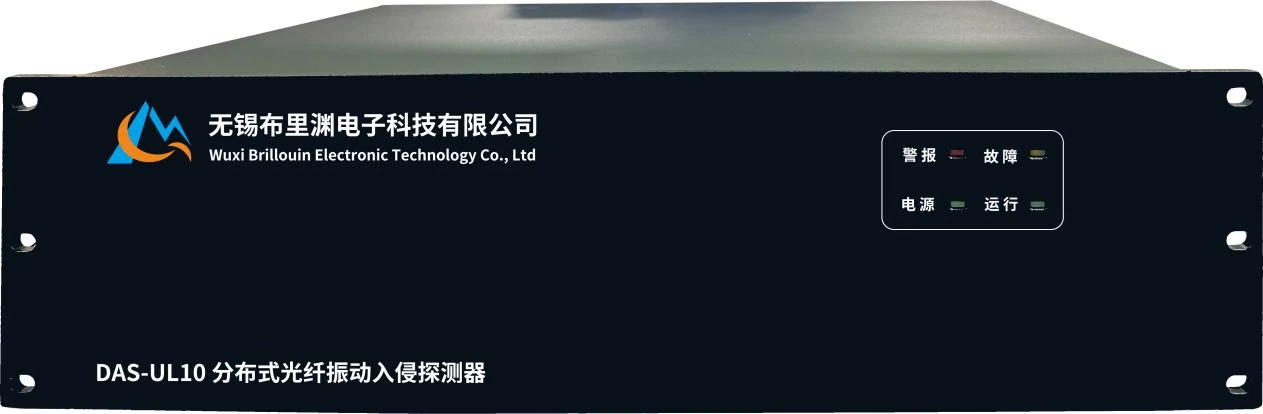
Product overview
Designed for long-range distributed vibration and acoustic monitoring using coherent phase interrogation. Select the model according to distance, physical channels and fading-suppression requirements.
Technology architecture
Each physical channel combines three bands and two orthogonal polarizations into six internal demodulation branches. Phase alignment and weighted complex-vector fusion produce the output; these branches are not six external fiber channels.
Phase output and audio reconstruction integrate with an external AI platform for GIS, event classification, model training, trend analysis and graded alarms.
Model selection
| Model | Maximum range | Physical channels | Scan rate | Application focus |
|---|---|---|---|---|
| DAS-UL10(N30) | 30 km | Default 1; optional 2 channels | 30 km @ 2 kHz | High fidelity |
| DAS-UL10(N70) | 70-100 km | Default 1; optional 2 channels | 70-100 km @ 1 kHz | Flagship long-range |
| Parameter | DAS-UL10(N30) | DAS-UL10(N70) |
|---|---|---|
| Max. Sensing Range | 30 km | 70-100 km |
| Product Positioning | High-end | Flagship long-range |
| Power | DC 24 V; approx. 20 W* | DC 24 V; approx. 30 W* |
| Scan Rate | 30 km @ 2 kHz adjustable | 70-100 km @ 1 kHz adjustable |
| Item | Specification |
|---|---|
| Core Architecture | 3 bands × 2 polarizations (X/Y) = 6 internal demodulation branches |
| Fusion Algorithm | Adaptive phase-aligned complex-vector fusion |
| Sensing Fiber | 9 μm/125 μm single-mode fiber |
| Physical Channels | Default 1; optional 2 parallel |
| Point Spacing | 0.4 / 1 / 2 / 5 m (configurable) |
| Gauge Length | 0.4–25 m configurable |
| Alarm Response | ≤3 s (minimum 1 s; acquisition and trigger settings apply) |
| Phase Accuracy | 0.1 rad typical |
| Audio Reconstruction | Supported |
| Vibration Range | 0.01 Hz–100 kHz* |
| Frequency Indication | ±1 Hz typical in conventional band |
| AI Platform | External standalone |
| Data Interface | 1×Gigabit Ethernet |
| Protocol | Custom phase-data protocol |
| Optical Connector | E2000; FC/APC optional |
| Laser Safety | Class 1 |
| Operating Temp. | -10 °C to 50 °C |
| Storage Temp. | -20 °C to 70 °C |
| Dimensions | 482.6 × 326 × 132.8 mm |
| Weight | Approx. 13 kg |
Frequency range depends on fiber length, scan rate, gauge length and SNR. The 100 kHz upper limit applies only to short-range configurations with adequate high-speed sampling, not simultaneously across a 30–100 km fiber. Conventional per-point temporal sampling must satisfy the Nyquist criterion with anti-aliasing margin.
An alarm response ≤3 s requires compatible acquisition and trigger settings. Low-frequency validation needs a sufficiently long observation window; 0.01 Hz analysis does not imply complete event classification within 1–3 s.
AI platform and applications
| AI Platform Item | Recommended Configuration |
|---|---|
| CPU | Core Ultra 5 225, 10 cores / 10 threads |
| Memory | DDR5-5600,16 GB |
| Storage | 1 TB; recommended sustained read/write ≥300 MB/s |
| Platform & OS | Golang + Vue3; supports Windows 10/11, Linux (e.g., Ubuntu 24.04) and domestic operating systems |
| AI Algorithm Platform | Web services, FFT, phase unwrapping/signal separation, GIS, AI training, classification, trend analysis, graded alarms and multi-protocol integration |
The AI computer is optional and excluded from the interrogator power rating. Confirm OS, browser and driver compatibility for the supplied software version.
Typical applications
Leakage, abnormal vibration, excavation, drilling, impact and illegal tapping warning.
Roller, bearing, belt tear, misalignment, friction, blockage and foreign-object fault localization.
Downhole leakage, fluid activity, casing anomalies and process monitoring.
Airports, borders, prisons, defense facilities, tank farms, substations and industrial parks.
Tunnels, rail transit, bridges, mines, submarine/land cables and long-range vibration monitoring.
Seismology, geophysical exploration, structural acoustics, wave propagation, audio reconstruction and algorithm validation.
Equipment interfaces
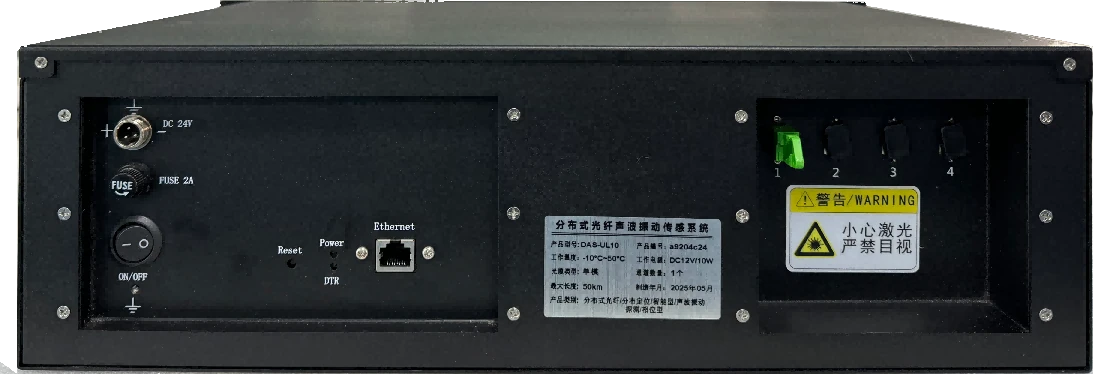
Interface layout, power and channel count depend on model and supplied configuration. Fiber sample spacing, gauge length and event-location error are distinct specifications.
Applications and further reading
- DAS monitoring of microseismicity, rockbursts and blasting in deep mines
- DAS seismic and ocean observation using subsea cables and urban dark fiber
Discuss your project with our engineer
Corporate Sales TeamCorporate contact
Contact us ↗