
DAS-UL10(10) / (20) · 一体化DAS主机
10/20 km一体化DAS主机,集成采集与边缘分析平台。
第4代一体式 DAS-UL10 分布式光纤声波振动传感系统
4th-Generation Integrated DAS-UL10 Distributed Acoustic Sensing System
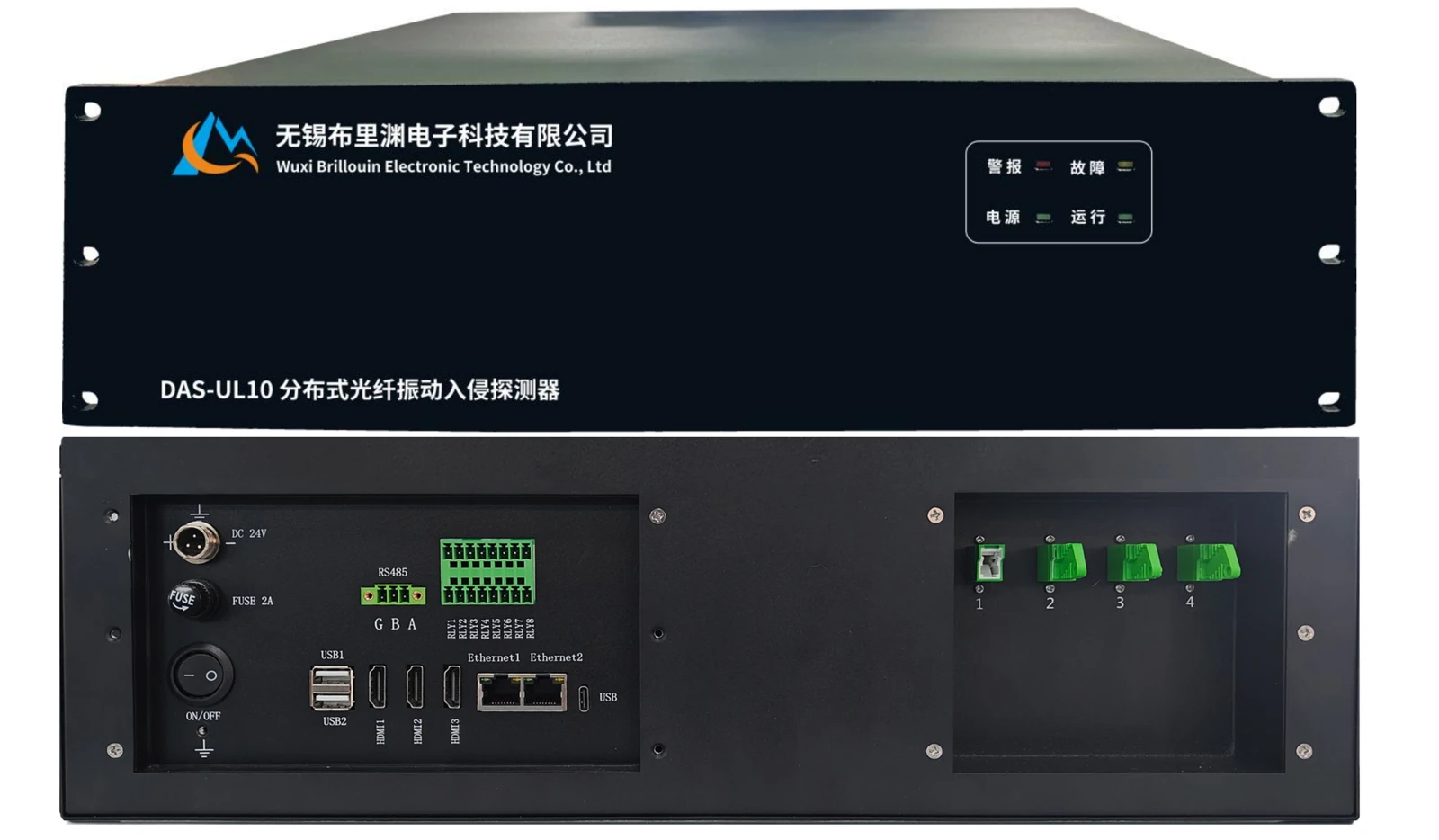
集成相干相位检测与8核AI边缘计算,支持多通道并行采集、波形与声音还原、事件识别及联动。
Integrates coherent phase sensing and an eight-core AI edge platform for parallel acquisition, waveform/audio reconstruction, event recognition and integration.
设备接口 Equipment interfaces
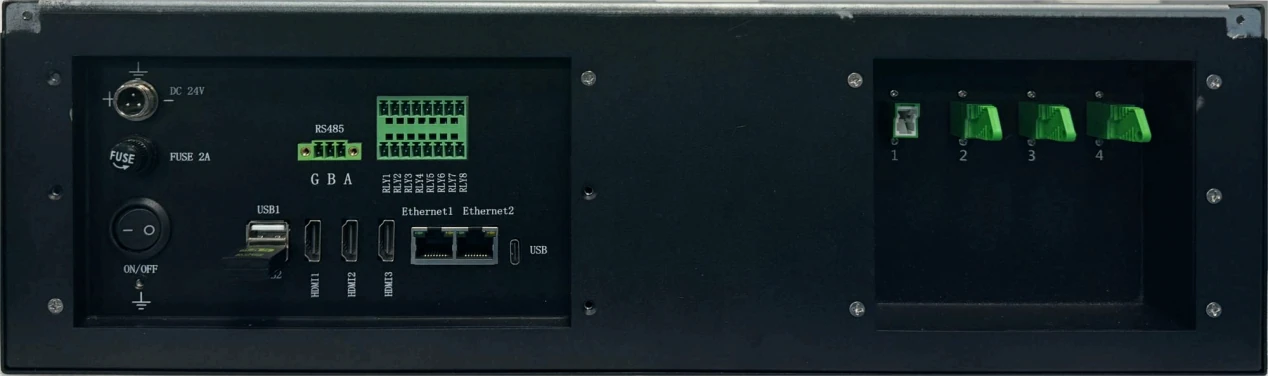
接口布局、功耗与通道数按型号和出厂配置确定;光纤采样间隔、标距与事件定位误差分别定义,不能互相替代。
Interface layout, power and channel count depend on model and supplied configuration. Fiber sample spacing, gauge length and event-location error are distinct specifications.
技术参数 Technical specifications
| 主机设备参数特性表 / Host Device Specification | DAS-UL10(10) Lite简化版 / Lite Simplified Version | DAS-UL10(20) Pro升级版 / Pro Upgraded Version |
|---|---|---|
| 最大测量距离 / Maximum Sensing Distance | 10 km | 20 km |
| AI算力模型 / AI Computing Model | 标准型 / Standard | 升级型 / Enhanced |
| 扫描频率 / Scan Frequency | 可根据光纤长度设置(10 km @ 10 kHz) Adjustable according to fiber length (10 km @ 10 kHz) | 可根据光纤长度设置(20 km @ 5 kHz) Adjustable according to fiber length (20 km @ 5 kHz) |
| 项目 / Item | 规格 / Specification |
|---|---|
| 设备类型 / Device Type | 相干相位检测型 Coherent phase-detection type |
| 光纤类型 / Fiber Type | 纤芯类型:单模光纤 9 um/125 um Fiber core type: single-mode fiber, 9 um/125 um 纤芯数量、外护套尺寸与材料特性根据工程应用场景配套 Core count, outer jacket dimensions, and material properties are configured according to the engineering application. |
| 测量通道数 / Number of Sensing Channels | 可选购 1/2/4 通道,原生多路物理硬件光学通道,并行实时同步采集,无时间盲区(非光开关切换轮询方式) Optional 1/2/4 channels; native multi-channel physical optical hardware channels with parallel real-time synchronous acquisition and no time blind zone (not based on optical-switch polling). |
| 采样间隔 / Sampling Interval | 0.4 m / 1 m / 2 m / 5 m 可设置 Adjustable: 0.4 m / 1 m / 2 m / 5 m |
| 空间测量设置 / Spatial measurement setting | 0.4–25 m(按项目配置;标距与定位误差分别确认) 0.4–25 m (project setting; gauge length and location error require separate confirmation) |
| 报警响应时间 / Alarm Response Time | ≤ 3 s(最小 1 s) ≤ 3 s (minimum 1 s) |
| 相位解调精度 / Phase Demodulation Accuracy | 0.1 rad(典型值) 0.1 rad (typical) |
| 声音还原功能 / Audio Reconstruction | 有 / Yes |
| 振动解调频率精度 / Vibration Demodulation Frequency Accuracy | 频率精度 ±1 Hz Frequency accuracy: ±1 Hz |
| 振动解调频率范围 / Vibration Demodulation Frequency Range | 0.1 Hz - 100 kHz(取决于光纤长度) 0.1 Hz - 100 kHz (depending on fiber length) |
| 内置平台 / Built-in Platform | 内置 8 核 AI 边缘计算平台(具备自学习能力与 AI 人工智能模型训练功能,包括 WEB 服务器平台、FFT 数据处理、分离解卷绕、GIS 地图、AI 智能场景训练分类与预警等功能) Built-in 8-core AI edge computing platform with self-learning capability and AI model training functions, including a web server, FFT data processing, separation and phase unwrapping, GIS mapping, AI-based scenario training/classification, and early warning functions. |
| 工作电压 / Operating Voltage | DC 24 V,平均功耗约 25 W DC 24 V, average power consumption approx. 25 W |
| 通信接口 / Communication Interfaces | 2 路 RJ45(千兆以太网)/ 1 路 RS485 / 2 路 USB / 标配 8 路继电器 / 3 路 HDMI 2 x RJ45 (Gigabit Ethernet) / 1 x RS485 / 2 x USB / standard 8 x relays / 3 x HDMI |
| 协议支持 / Supported Protocols | Modbus RTU / Modbus TCP / 自定义相位传输协议等 Modbus RTU / Modbus TCP / custom phase transmission protocols, etc. |
| 光纤接头 / Optical Connector | E2000 防尘自锁接头,可定制 FC/APC E2000 dustproof self-locking connector; FC/APC customizable |
| 激光安全等级 / Laser Safety Class | Class 1 |
| 操作温度 / Operating Temperature | -10 °C to 50 °C |
| 存储温度 / Storage Temperature | -20 °C to 70 °C |
| 尺寸 (W x D x H) / Dimensions (W x D x H) | 482.6 mm x 326 mm x 132.8 mm |
| 重量 / Weight | 13 kg |
频率范围与光纤长度、扫描频率、标距及信噪比共同关联。100 kHz上限仅适用于满足高速采样条件的短距离配置,不表示30–100 km全长同时具有100 kHz有效带宽。常规逐点时间采样须满足奈奎斯特条件,并预留抗混叠滤波裕量。
Frequency range depends on fiber length, scan rate, gauge length and SNR. The 100 kHz upper limit applies only to short-range configurations with adequate high-speed sampling, not simultaneously across a 30–100 km fiber. Conventional per-point temporal sampling must satisfy the Nyquist criterion with anti-aliasing margin.
≤3 s报警响应需满足采集与触发设置;低频能力验证需覆盖足够长的观测时间,不能将0.01 Hz低频分析与1–3 s完整事件判别时间等同。
An alarm response ≤3 s requires compatible acquisition and trigger settings. Low-frequency validation needs a sufficiently long observation window; 0.01 Hz analysis does not imply complete event classification within 1–3 s.
应用与相关阅读
与销售工程师聊聊您的项目
公司商务服务团队公司统一服务窗口
联系我们 ↗