
Teaching experiments, research measurements and custom instruments
DTS, DAS, BOTDA/BOTDR, FBG and silicon photonic point sensing
Repeatable experiments, traceable data and clearly defined interfaces and deliverables
From demonstration instruments to reproducible experiments
University teaching and research platforms have different requirements from long-term field alarm systems. Teaching should explain the measurement chain, parameter meanings and error sources; research needs original conditions, repeatable experiments and comparisons between algorithms; custom instruments need defined interfaces, versions and deliverables. Establish experimental objectives before choosing interrogators, sensing heads, cables and software. The number of instrument types is not the sole measure of platform quality.
This solution supports practical teaching and applied research in photonics, instrumentation, automation, civil engineering, energy and related disciplines. Modules cover Raman distributed temperature sensing (DTS), distributed acoustic/vibration sensing (DAS), Brillouin temperature/strain sensing (BOTDA/BOTDR), FBG and silicon photonic point sensing. Configure them in phases according to curricula and research directions; a basic teaching platform need not include every advanced research function.
Define experimental tasks and measurement objects separately
First build an experimental task list. For each task, specify the measured quantity, excitation method, reference instrument, recorded data and evaluation criteria. Temperature experiments concern stable heat sources, temperature distributions and dynamic response; vibration experiments concern excitation, spectra, propagation and installation direction; strain experiments concern loading, thermal cross-sensitivity and force transfer. Explicit conditions make it possible to determine whether results support the intended conclusions.
Teaching demonstrations and research measurements may use similar equipment, but data access, repeatability and software permissions need separate planning. Teachers manage experiment configuration and equipment protection; students receive appropriate observation and processing functions. Confirm researchers' access to raw data or custom processing interfaces as separate capabilities. Unconfirmed interfaces must not be assumed available in a teaching plan.
DTS temperature profiles and spatial response
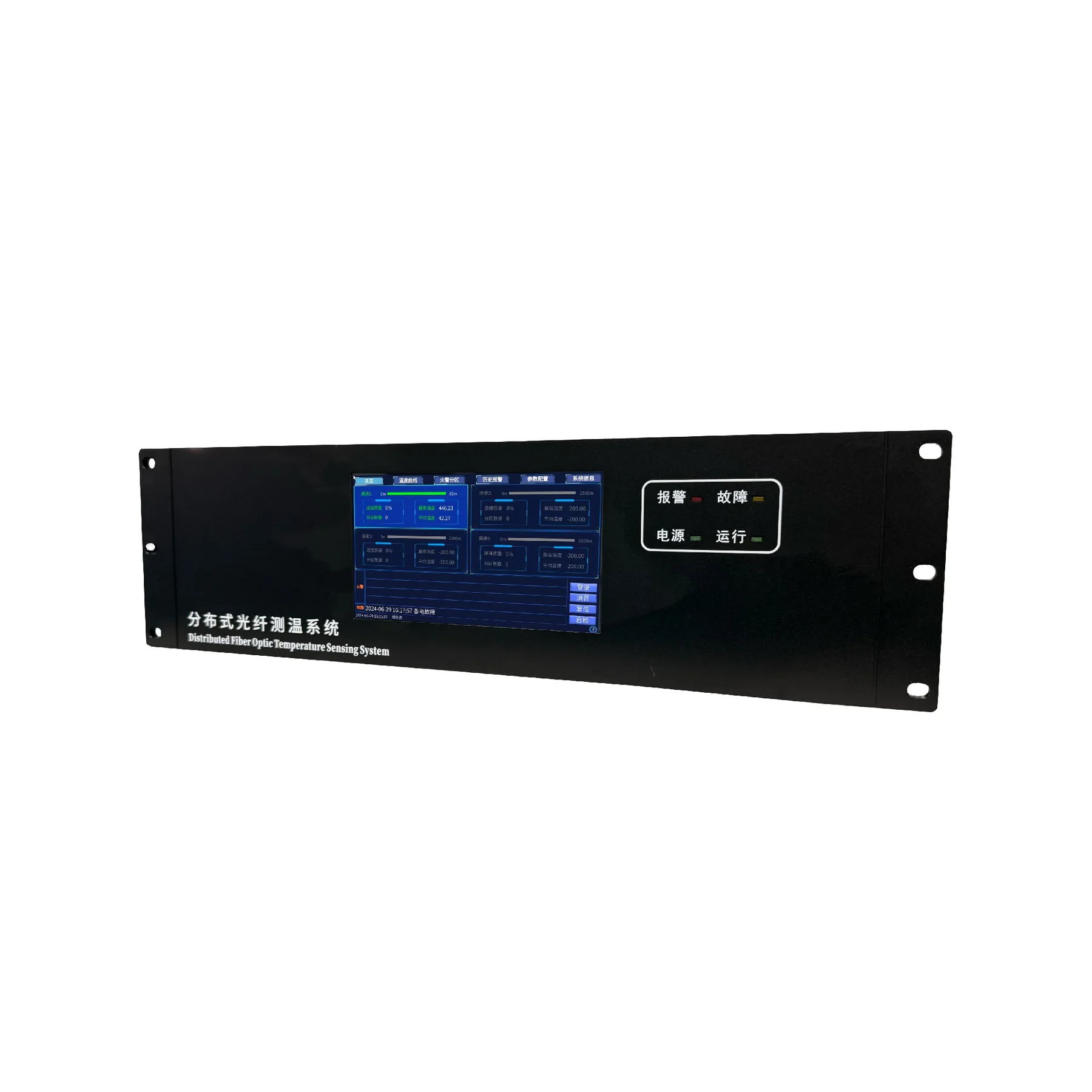
A basic DTS experiment routes fiber through stable-temperature, ambient-reference and controlled-transition zones to record temperature profiles. Ensure comparable reference temperatures and document cable jackets, immersed length, fastening and thermal-equilibrium conditions. Label optical distance separately from physical bench position; exclude joints, slack loops and lead-out fiber from measured sections.
Evaluate spatial resolution, sampling interval and temperature accuracy separately. A smaller sampling interval displays more points but does not prove that equally small heated zones are resolved. Vary effective heated length and compare temperature-step responses to demonstrate averaging caused by finite spatial response. Dynamic experiments must distinguish cable thermal inertia from instrument measurement time instead of treating them as one response speed.
DAS acoustic/vibration acquisition and event analysis
Use controlled vibration at known locations to compare DAS signals under different mounting methods, excitation frequencies and background interference. Record fiber routes and installation, and ensure excitation frequency and location can be verified. Tapping, loudspeakers or mechanical vibration can demonstrate response, but records must specify the excitation rather than merely show an attractive waterfall plot.
Distinguish signal acquisition from event recognition. Verify time and distance axes, units, sampling parameters and data formats before filtering, feature extraction or classification. Separate training and independent validation data by event or experimental batch; splitting slices of one event between both sets can inflate evaluation scores. Retain waveforms and experimental labels with recognition results to investigate errors.
BOTDA/BOTDR and structural strain experiments
Use specimens with defined loading and measurable geometry, recording how fiber connects to the structure. Bonded, embedded and anchored installations transfer force differently. Instrument strain is not automatically the strain at any arbitrary structural location. Store fiber direction, effective length, bonded area and lead-out protection with the specimen identifier.
Brillouin measurements are sensitive to both temperature and strain. Include temperature references or suitable compensation and decoupling. Single- and double-ended measurements impose different access, connection and experimental requirements; confirm these during selection. Crack and local-deformation research must also assess spatial response and effective sensing length, avoiding direct conversion of local peaks into crack width or overall load capacity.
Point sensing and multi-parameter comparisons
FBG, silicon photonic and other point-sensing modules support temperature, vibration, pressure and other suitable measurements at defined locations. Describe each head's sensing principle, packaging and interrogation requirements independently; shared fiber transmission does not make heads interchangeable. Mark coordinate directions for three-axis vibration, verify medium compatibility and process connections for pressure, and record thermal contact for temperature experiments.
Comparisons between distributed and point sensing require comparable objects and references. Point sensors focus on local positions; distributed sensing provides information along a route. Neither is simply a superior replacement for the other. Comparing measurements on one object helps learners understand spatial coverage, installation, bandwidth and error, and why engineering projects combine technologies.
Software, data interfaces and development environments
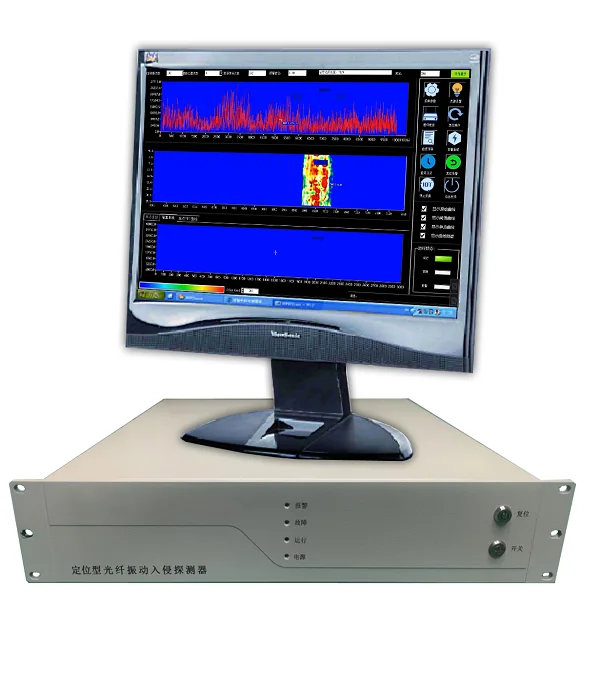
Separate equipment access, data recording and research analysis in the software. Equipment access manages channels and acquisition; recording preserves experimental conditions and original results; analysis supports student assignments and research algorithms. This enables secondary processing without arbitrary changes to low-level equipment settings and simplifies restoring the bench after a course.
Custom interfaces must define transmitted data types, update frequency, timestamps, units, fault states and communications. Before developing Python, MATLAB or other analysis integration, confirm available protocols, documentation and example scope. Browser-based curves can display results but do not establish that all raw samples are accessible.
Experimental records and data traceability
Each experiment needs traceable records: experiment ID, hardware/software versions, sensing fiber or head identifiers, optical connections, settings, environment and excitation. Record reasons and before/after versions when changing filters, averaging time, calibration or compensation. Charts should identify axes, units, acquisition range and processing methods rather than present isolated curves without context.
Retention should reflect course cohorts and research periods. Archive teaching data by class and task, and research data by specimen, condition and processing version. Keep original data separate from derived results and preserve processing scripts or calculations. Flag uncertain or poor-quality sections; interpolation or smoothing must not hide fiber breaks, saturation or lost coupling.
Custom instrument and software deliverables
Prepare a clear technical brief covering optical interrogation, sensor packaging, channels, mechanics, acquisition, software and external interfaces. Research objectives may be exploratory, but acceptance needs executable conditions. Separate effects still requiring research validation from deliverable instrument functions; hypotheses must not become guaranteed equipment specifications.
Describe software requirements using real samples and operating scenarios, such as acquiring a specified channel, recording tests, exporting results or supporting algorithm plugins. Record how changes affect acquisition, storage and testing, and define updates and maintenance. For integration with existing instruments or third-party platforms, jointly confirm interfaces and commissioning responsibilities.
Safety, permissions and equipment protection
Teaching laboratories have many users. Establish procedures for fiber ends, laser safety, electrical connections, heat sources, mechanical loading and pressure equipment. Do not look into fiber ends or disconnect/open equipment without confirmed safe conditions. Thermal, loading and pressure experiments need appropriate protection and competent supervision. Passive sensing fiber does not remove electrical, thermal or mechanical hazards from the bench.
Separate equipment administration from data viewing. After experiments, check acquisition, heat sources and excitation devices and restore the approved configuration. Define boundaries between teaching and public networks and authorize remote access. Keep login details out of public course pages; assign configuration backup and recovery to responsible personnel to protect subsequent experiments.
Acceptance and phased expansion
Use mutually agreed experimental tasks as the acceptance framework, checking sensing objects, interrogation, data recording and presentation. Verify references and spatial response for temperature; controlled events and location correspondence for acoustics/vibration; loading and temperature compensation for strain; and calibration, orientation or range for point sensing. Also check behavior during optical disconnection, network failure and insufficient permissions.
Phased deployment can begin with basic temperature or acoustic/vibration experiments, followed by structural and point-sensing modules. Specify reserved rack space, fiber interfaces, data capacity and software integration rather than promising unlimited expansion. Reconfirm experimental objects and interfaces for each added module, retaining configuration and acceptance records so earlier courses remain usable.
Platform outcomes and engineering applications
A sustainable platform lets teachers repeat experiments, students explain results and researchers trace data conditions. Assess task completeness, verifiable data, safe operation, clear versions and defined interfaces for later research. Images and demonstration curves support teaching; research conclusions still require suitable experiments and analysis.
Laboratory work can connect cable hotspots with power applications, controlled vibration with pipeline excavation protection, and structural loading with bridge monitoring. Before transferring bench results to the field, reassess distance, coupling, noise and installation conditions. This creates an explainable and verifiable connection between teaching and practical applications.
Related products and technical pages
Related equipment and specifications
Select the final model and installation to suit project conditions.
DTS-BLY-5S(ADV-10km)
Multimode 10 km DTS
DAS-UL10(A30) / (A70)
Generation 4.5 engineering DAS
BOTDA1000
Distributed fiber temperature & strain analyzer
BOTDR1000
Brillouin optical time-domain reflectometer
BLY-SOACC-3-XXX
Three-axis silicon photonic accelerometer
BLY-SOACS-1-XXX
Fiber-optic acoustic signature sensor
BLY · DTS / DAS / BOTDA / BOTDR
BLY sensing cables